
Every year, over four million US citizens turn eighteen and gain the right to vote. These new Gen Z voters were born after 1996 and will amount to over 24 million possible voters or 10% of the electorate in 20201. With young people voting Democratic by wide margins, they could easily swing the election if they vote and are targeted. The Democratic Party and political action committees (PACs) should target these young voters to win the 2020 election.
- pin up
- pin up az
- mosbet casino
- pinup casino
- mostbet online
- pinup az
- 1vin
- mosbet casino
- mostbet
- pin up casino india
- mostbet az
- mostbet aviator
- pin up uzbekistan
- mostbet
- pinko casino
- 1 win az
- mostbet casino
- pin up uz
- mosbet casino
- 1win
- snai it
- lucky jet slot
- 1win
- pin up
- 1 win
- 1 win
- 1win casino
- 4era bet
- 1 win
- mosbet
- mostbet az
- pin up casino uz
- mostbet
- mostbet
- 1win casino
- pinup
- mostbet
- pinup
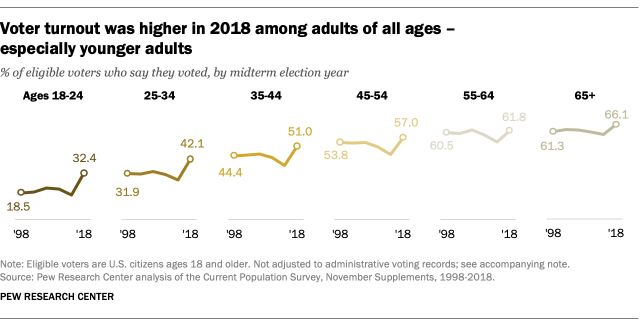
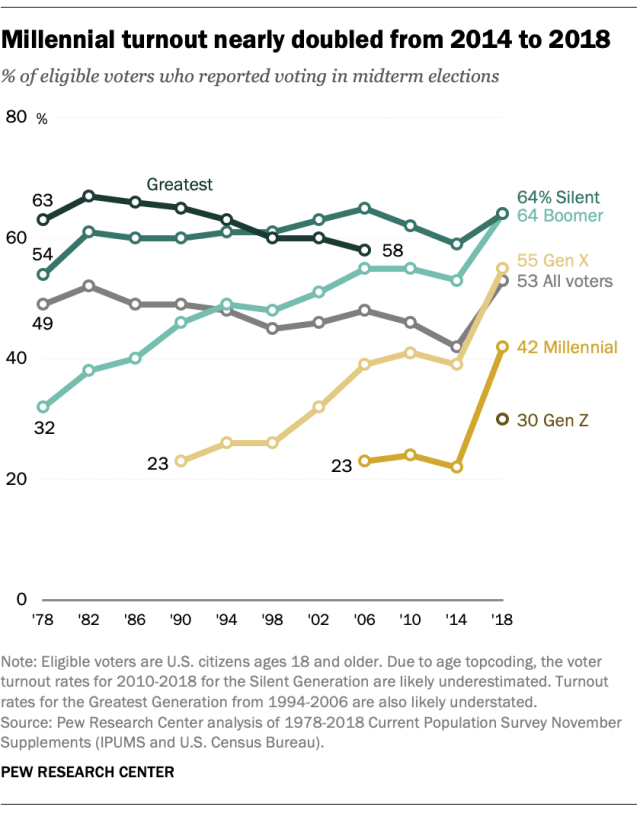
Millennial and Gen Z generations will be from 18-39 years old in 2020 and these young voters typically vote the least of any generation. Even though their future will be influenced the most by government policies over their lifetimes, their voter turnout in the 2016 election was only 51%2. The 2018 midterm elections show that these young voters are considerably interested in voting and their voter turnout reached the highest levels in over two decades as seen in Figure 1. If Gen Z would vote at the rate of Boomers, the 2020 election could easily be shifted towards the Democratic party.
In 2016, Millennials, or Generation Y, voted on the national average of 55% Democratic and 33% Republican2. For each one hundred new, young voters, 22 additional democratic votes will be counted if this trend holds. Nineteen million additional Gen Z voters will be eligible to vote in 2020 since five million Gen Zers were already eligible for the 2016 election. If Gen Z voted in a similar pattern to Millennials in 2016, there would be an additional 2.1 million votes for Democrats (19 M additional Gen Z voters * 51% turnout rate *22 Democratic Votes over Republicans per 100 voters). These 2.1 million more Democratic votes have a huge impact on already tight elections.

An interesting analysis shows how an additional 2.7 million Democratic votes would have influenced the 2016 election. Trump won the 2016 election by 77,744 votes by flipping the rust belt states of Michigan, Wisconsin and Pennsylvania. If these 2.7 million new Democratic votes were spread evenly across the US based on population, then the results would be much different. If these hypothetical Gen Z voters turning out at 51% and yielded 22 more Democratic votes per one hundred, they would have easily flipped these three states and Florida!
Table 1: Additional Gen Z Voters Swing the Election in Four States
| State | Votes Trump Won By | Additional Gen Z Democratic Votes |
| Michigan -16 | 10,704 | 67,480 |
| Wisconsin – 10 | 22,748 | 38,967 |
| Pennsylvania – 20 | 44,292 | 113,307 |
| Florida – 29 | 112,911 | 132,776 |
Table 1 shows how four more years of Gen Z voters could have swung the election in favor of Hillary Clinton if national averages applied to these states. Hillary would have won the election 307-231 in the Electoral College.
This flip in the 2016 election due to new Gen Z voters is based a few assumptions and here are some comments about how the 2020 election might pan out:
- 51% of the new Gen Z voters vote – I’m pretty
optimistic that this assumption will be surpassed in 2020 because Trump is so
dividing that he motivates people to vote. - 55 out of every 100 new voter vote Democratic
and 33 vote Republican – This is much more up in the air and problematic to
determine. With 45% of Gen Z being of
color, the demographics favors the Democrats.
If the Democrats play to the younger crowd, then they have a better
chance. - Battleground states vote like the nation did in
2016 – Of course this is a major leap and I’ll look into this in more detail in
a later blog. - Nothing else changes – Of course many things
will change in the 2020 election. From the
Democratic candidate to trade wars, many things will change in 2020 and I’ll
look at these individually as they come up.
To conclude, Gen Z voters will add 19 million new voters and make up 10% of the electorate in 2020. While Boomers and older generations decline, Gen X and Millennials will grow by about 2.5 million voters or 1% of the electorate from immigrants naturalizing and getting the right to vote3. These demographic shifts favor the Democrats and these younger X, Y and Z generations are now the majority of voters and should be targeted. Most older voters are already set in their ways. The future belongs to the young and those who court them.
To subscribe to my blog, go here:
- https://www.pewsocialtrends.org/essay/an-early-look-at-the-2020-electorate/
- https://www.pewresearch.org/fact-tank/2017/07/31/gen-zers-millennials-and-gen-xers-outvoted-boomers-and-older-generations-in-2016-election/
- https://www.pewresearch.org/fact-tank/2019/05/29/gen-z-millennials-and-gen-x-outvoted-older-generations-in-2018-midterms/ft_19-05-23_generationsvoting_millennialturnoutnearlydoubled20142018/